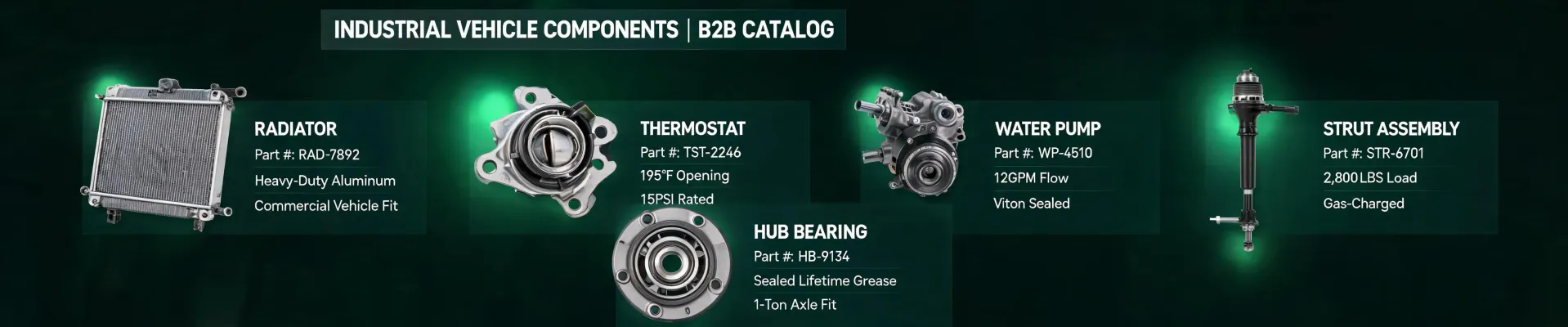
If you're sourcing automotive parts and you don't have a system to double-check the one-sentence spec on the drawing, you are going to lose money. Period. I learned this the hard way with a radiator cap order in September 2023 that cost me $1,400 and a pissed-off client.
How I Got Here: The Radiator Cap That Almost Cost Us a Client
I'm not a design engineer. I'm a guy who handles stamping, forging, and CNC machining orders for OEM automotive suppliers. For about six years now. My job is to take a customer's drawing and turn it into a tangible part. I've made (and documented) roughly 18 significant mistakes in that time, totaling around $12,000 in wasted budget—either in rework, scrapped material, or late delivery penalties.
The radiator cap incident was my personal 'no-no' moment. A client came to us needing a batch of custom koyo radiators for a restoration project. The spec was clear: 'Standard 16 PSI cap.' Simple, right? We sourced the caps, assembled the radiators, shipped them. Next thing I know, the client is screaming because the caps are venting pressure at 14 PSI. The engine was running way hotter than expected. We had to pull 30 units—maybe 28, I'd have to check the invoice—apart, drain the coolant, replace the caps, and re-test every single one. The labor alone was brutal. $1,400 wasted, credibility damaged, and lesson learned: never trust the generic spec. Always verify the operating parameters.
What most people don't realize is that a 'standard' koyo radiator cap is not a universal part. The sealing gasket compound, the spring tension, and the venting mechanism all need to match the thermal expansion rate of the specific coolant system. Something vendors won't tell you: they often quote the cheapest generic cap to win the bid, not the one that fits your application.
That's when I created a pre-check list for parts that have high tolerance for failure but low tolerance for cost. This article is that list.
The Real Cost of a Small Part: Why This Matters
We talk about dirty fuel injector symptoms or what makes alternator go bad, but we often ignore the root cause of the repair: a crappy spec or a bad installation. A single bad part doesn't just fail; it takes other parts with it.
I've seen it happen with a piston de motor (engine piston). A client ordered pistons from a low-cost supplier. The pin bore tolerance was off by less than .005 inches. On paper, it looked fine. In reality, the wrist pin seized, the connecting rod snapped, and the piston punched a hole through the block. That wasn't a piston failure; that was a spec failure.
My Three-Step Verification Process for Critical Components
After the radiator cap fiasco, I changed my process. It's not about being perfect; it's about catching the small things that kill a job.
Step 1: The 'What's NOT Included' Question
I've learned to ask 'what's NOT included' before 'what's the price.' The vendor who lists all fees upfront—even if the total looks higher—usually costs less in the end. For a koyo radiator, the cap price is one thing. The sealing ring material, the corrosion coating, and the pressure testing certification are often separate line items. The vendor who hides those is the vendor who will mess up your order.
Step 2: The 'Worst Case' Test
I imagine the part being used at the absolute limit of its spec. Will that koyo radiator cap hold at 18 PSI on a 95-degree day? If the drawing says '16 PSI,' we test at 18 PSI. If it fails, we know the cap is a boundary-case risk. This saved us on an alternator bracket order. The design was fine for normal vibration, but we simulated highway cruising at 75mph. The bracket flexed. We caught the failure before it hit the road.
Step 3: The 'One-Sentence' Rule
Someone on my team has to be able to describe the part's critical function in one sentence. 'The koyo radiator cap provides a 16 PSI seal to prevent coolant boil-over at peak operating temperature.' If they can't say that, we don't know what we're making. We go back to the drawing.
When This Doesn't Work (And What To Do Instead)
I have mixed feelings about this checklist system. On one hand, it has saved us a ton of time—maybe 47 potential errors caught in the last 18 months. On the other, it adds two days to the start of a project. For standard items like cap screws or simple brackets, it's overkill. For critical parts like alternators, injectors, and pistons, it's a no-brainer.
This gets into metallurgy territory, which isn't my expertise. I'm not a materials scientist. I can't tell you the exact chemical composition of a spring steel in a relay. But I can tell you from a procurement perspective how to evaluate a supplier's testing promise. If they can't show you their test data for the 'what makes alternator go bad' scenario (excessive heat cycling, voltage spikes), walk away.
Also, don't assume a higher price equals better quality. A local job shop quoted us $8 per cap for 'custom.' They were just re-packaging the same generics. Our trusted supplier in China gave us a $2.50 cap with full testing data. The honest supplier listed the material origin and the test pressures. The $8 shop listed nothing. Transparency is worth more than a discount.
If you're ordering parts like koyo radiators, custom pistons, or any CNC car part, my advice is simple: forget the price list. Ask for the test data. Ask for the failure scenarios. If the sales guy looks at you weird when you ask about the cap venting curve, he's the wrong guy. Run.
— A guy who wasted $1,400 so you don't have to.

Elise Novak
Elise Novak is an automotive braking systems analyst specializing in brake pads, discs, rotors, calipers, shoes, drums, hoses, and complete brake kits. She uses UN Regulation 90 requirements and ISO 26867 dynamometer methods to examine friction stability, fade and recovery, wear, disc thickness variation, runout, and hydraulic integrity. Her work helps distributors, quality teams, and fleet buyers compare replacement parts, verify application suitability, and define incoming-inspection criteria.