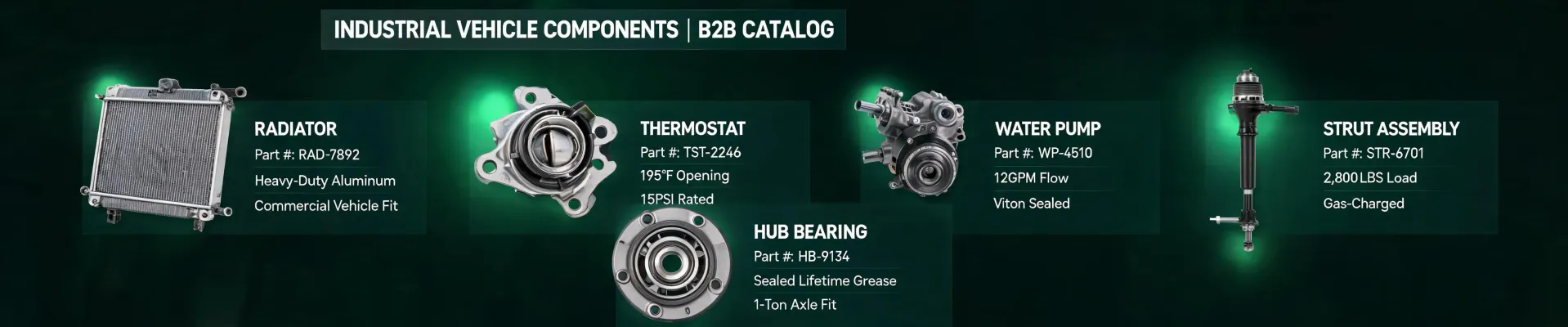
In March 2024, I coordinated a radiator delivery for a 2005 RSX with less than 24 hours before the customer's track weekend. Normal ground shipping was four to five days, and the event package was already paid. We paid an extra $126 for overnight freight and got the car running. The thing that saved the job was not the freight. It was the part-number comparison done before we clicked buy.
Bottom line: for an 02-06 RSX, do not buy by the words 'fits RSX' alone. Compare the OEM-style Honda number, the KOYO engineering number, and the physical layout, especially automatic vs. manual transmission oil-cooler lines. If the coolant is already out, also check the KOYO oil seal catalogue for oil leaks you can see while the radiator is removed. Then, before returning the car, test whether the alternator is draining battery. A surprising number of charging-system failures show up right after a cooling system job because the driver stops worrying about temperature and then discovers the electrical problem.
KOYO Radiator RSX 02-06 Part Number Comparison: What Actually Matters
The RSX used several engine versions between 2002 and 2006: the base K20A3, the 2002-2004 Type-S K20A2, and the 2005-2006 Type-S K20Z1. Within those, automatic transmission models can require a different radiator because the radiator has or connects to an automatic transmission fluid cooler. If you compare only the year range, you can end up with a good-looking radiator that is wrong for the transmission.
When you search for a KOYO radiator RSX 02-06 part number comparison, you will usually see two numbering systems. Honda's original part number is often a nine-digit number starting with something like 19010-Pxx-xxx. KOYO's own catalog number will not look like that, and it may not even be the same as the number stamped on an original KOYO-branded radiator. That is normal. Supplier part numbers change over time, so what matters is the physical match, not the name.
- Check the engine code on the car, not just the trim level.
- Look at the old radiator before removal: does it have transmission oil cooler lines?
- Confirm that the replacement has the same port layout and line fittings.
One surprise I keep seeing is that the exact same radiator can appear under several different part numbers depending on the supplier, the production batch, or whether it includes the caps and brackets. That does not automatically make one version better than another. But it does mean you should not assume a lower-priced listing is a better deal. Compare the parts that matter: the core size, the tank mounting points, and the ATF cooler arrangement.
The other thing I tell customers is to watch out for listings that claim they fit every 2002-2006 RSX. On this generation, the automatic transmission version is where fitment mistakes happen. A manual-transmission radiator can be installed on an automatic car if someone ignores the cooler lines, but the transmission will overheat quickly. We caught one of those mistakes before the car left the shop. So glad we checked.
Read the KOYO Oil Seal Catalogue with Calipers, Not Guesswork
Once the radiator is out, the front of the engine is much easier to inspect. That is when many people notice a second problem: a slow oil leak from a camshaft seal or crankshaft seal that was hidden behind the lower fan shroud. It is not always related to the radiator failure, but it is smart to decide whether you want to pull the engine apart again later. If the seal is already wet, the labor is already partially done.
The KOYO oil seal catalogue is useful here, but you have to read it the right way. KOYO lists many seals by dimensions first, usually in millimeters: shaft diameter x housing bore x seal width. For example, a common Japanese engine seal might be something like 35 x 52 x 8. If you search only by vehicle name, you may get a superseded number or a part that was grouped incorrectly by an online retailer.
When I am helping a shop order a seal, I ask them to measure the old seal with calipers. If the old seal is too damaged to measure, use the shaft and the housing bore instead. Also check the seal code format: TC, TB, or SC-type seals have different lip arrangements. A double-lip seal is often better for a front crank seal because it keeps dirt out, but you need to match the original style and the installation direction.
Seal prices are usually not the painful part. The labor is the expensive part. That is why a transparent quote matters more than a cheap-looking seal number. I'd rather see a slightly higher seal price and a clear line-item for the labor than get a hidden surprise later.
How to Tell if an Alternator Is Draining Battery (2007 Honda Accord Example)
The phrase 'alternator draining battery' can mean two different things. The first is a key-off draw: something keeps pulling current after the car is shut off. The second is insufficient charging: the alternator is so weak that the battery goes dead while you drive or after repeated short trips. Both can feel the same when the car will not start.
I have traced this exact problem to an alternator on a 2007 Honda Accord. The initial mistake is easy to make: replace the battery, drive for a week, then find the battery dead again. A bad rectifier or regulator inside the alternator can let DC current leak backward through the charging circuit when the engine is off.
The fast way to test for key-off drain:
- Disconnect the negative battery cable.
- Put a digital multimeter in DC amp mode between the negative battery post and the negative cable clamp.
- Wait 15 to 60 minutes if possible so the car's modules go to sleep.
- Check the reading. Normal key-off draw is roughly 20 to 50 milliamps on most modern cars.
- If the reading stays above that, start pulling fuses or disconnecting components until the current drops.
When the alternator is the source, disconnecting the 2-pin alternator connector often makes the milliamps fall to near zero. In one 2007 Honda Accord example, the draw was about 180 milliamps. That does not sound huge, but it is enough to kill a fully charged battery in a couple of weeks if the car sits.
If the battery drains while driving rather than while parked, check charging voltage with the engine running. At the battery, you should see roughly 13.8 to 14.6 volts DC. Then switch the multimeter to AC volts and check the same battery terminals. More than about 0.5 volts AC means the alternator diodes are failing. That creates ripple that the battery has to absorb, and the alternator cannot supply clean power to the car.
Free Headlight Bulb Installation? Compare the Total, Then Do It Yourself
Once you have the charging system sorted, take a look at the headlights as well. A weak charging system makes old bulbs look even more yellow and dim. Some parts stores advertise free headlight bulb installation, and that is not always a scam. It can be a genuine service when you buy the bulb from that store. But I keep seeing the same catch: a $25 bulb marked up to $45 because the labor is 'free.'
A store that posts free headlight bulb installation may still give you a fair total price. A store that charges $80 for installation may have a $22 bulb. The number that matters is the price out the door.
If you own an 02-06 RSX or a 2007 Accord, headlight bulb replacement is normally a DIY job. On most of these cars, you do not need to remove the bumper. Unplug the harness, release the clip or retainer, and pull the bulb straight out. Use a clean glove or a lint-free cloth to handle the new bulb; oil from your skin shortens bulb life. Even with normal speed, the job usually takes 15 to 25 minutes per side and can save you $80 to $120 in labor.
Where I'd Push Back on This Checklist
At least, that has been my experience on these 2000s-era Honda platforms. But this is not a universal catalog, and I am not claiming to speak for KOYO or Honda. If the car has been in a front-end collision, or if the engine was swapped, part-number comparison may not be enough. The used radiator that came out of the car is still the best visual reference. Take photos of it before you remove it.
The seal dimensions, oil cooler lines, and electrical tests I described here are general guidance. Your specific RSX trim or Accord trim may use a different cooling layout, and some alternator draws come from a faulty cooling fan relay rather than the alternator itself. If anything does not match the old part, stop and verify before ordering.
Prices and freight figures in this article were from recent jobs I remember, but I might be misremembering a detail or two. Freight rates and product availability change quickly, so treat those numbers as examples, not quotes. When in doubt, ask your parts supplier to compare the old part number against the proposed replacement.
One last thing: don't let a fresh radiator give the customer false confidence. These cars are now old enough that seals, alternators, and bulbs fail around the same time as the original cooling system. The radiator is often the first signal, not the last. Fixing it together with the oil leak check and a basic charging system test is a lot cheaper than a second tow truck trip.

Elise Novak
Elise Novak is an automotive braking systems analyst specializing in brake pads, discs, rotors, calipers, shoes, drums, hoses, and complete brake kits. She uses UN Regulation 90 requirements and ISO 26867 dynamometer methods to examine friction stability, fade and recovery, wear, disc thickness variation, runout, and hydraulic integrity. Her work helps distributors, quality teams, and fleet buyers compare replacement parts, verify application suitability, and define incoming-inspection criteria.