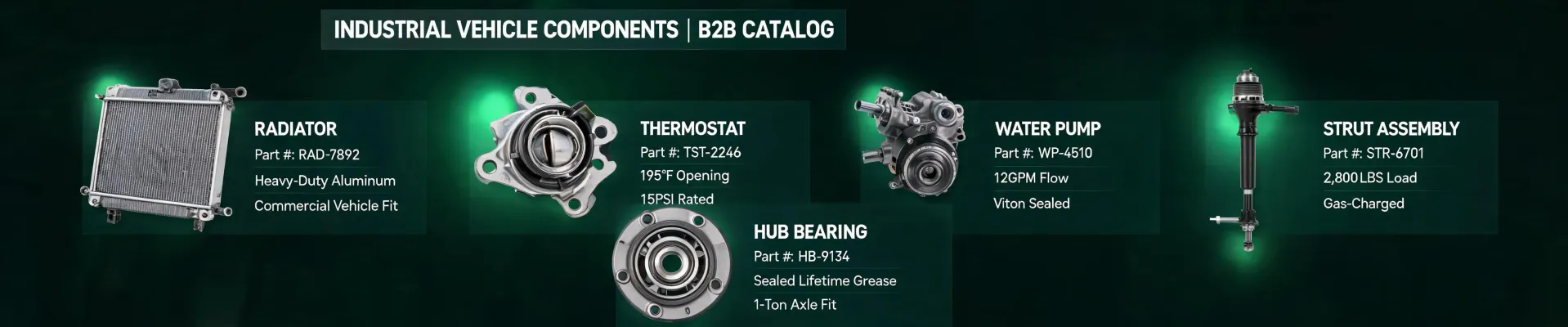
Stop buying the brand you know. Start buying the part that actually fits your setup. I learned this the hard way: on a $2,100 order for what I thought was a universal Koyo radiator, I ended up with a pile of aluminum that didn’t line up with the K20 swap mounts. That mistake alone cost $390 in return shipping, a 12-day delay, and a very angry shop foreman. Six years and roughly 47 documented errors later, I maintain our team’s pre-order checklist — and the single most important rule is: your car’s specific application matters more than the brand badge.
If you remember nothing else from this article, remember this: the cheapest or most famous part is rarely the best one for your configuration. Now let me show you the three biggest traps I’ve walked into — and how you can avoid them.
1. The Koyo Radiator Trap – Brand Loyalty Almost Cost Me a Month of Shop Time
When I first started sourcing cooling components in 2018, I heard everyone rave about Koyo radiators. “Just get a Koyo, they’re the best for K-swaps.” So I ordered a Koyo radiator cap and a full-size Koyo radiator for a Honda K24 swap. It arrived, looked gorgeous, and wouldn’t fit. The upper hose inlet was positioned 2 inches too far to the left — incompatible with the 70mm throttle body we were running.
The total cost of that single assumption: $1,200 for the radiator, $140 for the cap, $300 in custom fabrication to make it work (which failed), plus $320 in return shipping and restocking fees. I still kick myself for not checking the exact Koyo part number against our engine bay layout.
Here’s what I learned: Koyo makes excellent radiators — for specific vehicles and swaps. The “Koyo K-Swap Radiator” is a real product line, but not every Koyo radiator labeled for a K-series fits every K-swap. You need to match the vehicle chassis, engine orientation, and even the radiator cap pressure rating (PSI) to avoid overheating or hose blow-offs. A universal Koyo unit without application verification is a $2,000 paperweight.
Same logic applies to air filters. I once ordered a set of high-performance conical filters (the popular “air filter types” list) assuming any would work with our turbo setup. I chose a dry filter because I thought oiled filters would clog the MAF sensor. But the diameter was 5 mm too small — the turbo inlet hose couldn’t seal, and we sucked unfiltered air for a week (discovered during a leak test). That small oversight cost $170 in replacement filters and a $90 re-tune.
Pro tip: when someone says “just get a Koyo radiator cap” without asking your radiator’s core thickness or coolant type, walk away. Ask for the specific OE replacement number or the exact swap guide they’ve used.
2. Car Alternator Replacement – The “Plug-and-Play” Lie
Alternator replacement seems straightforward: match the voltage, amperage, and mounting brackets. In 2020, my colleague needed a new alternator for a tuned 2JZ-GTE. We bought a remanufactured unit from a well-known brand — 140 amps, looked identical. Installed it, and within 500 miles the voltage regulator failed, frying the ECU. Total damage: $1,200 for the alternator + $850 for ECU repair + towing.
The root cause? The replacement alternator had a different internal regulator design that didn’t handle the high-rev spikes from the built engine. The spec sheet said it was a direct replacement, but it wasn’t designed for our specific rev range (8,000+ RPM).
Since then, I’ve developed a rule: never trust “direct replacement” without verifying the application’s field current curve and pulley ratio. Use the OEM part number cross-reference, not the brand name alone. If you’re swapping a BMW alternator into a different chassis, even the physical fitment might require custom brackets — something most catalogs won’t tell you.
I have mixed feelings about aftermarket alternators. On one hand, they save money. On the other, the failure risk can exceed the savings. Now I recommend sticking with OEM rebuilds for daily drivers and only using specialized high-output units (like those from engineering shops) for race cars — but only after confirming the supplier has tested them on your engine family.
3. The Thermostat Decision – Ecobee vs Nest? Just Pick the Right Temperature Range
You might wonder what Ecobee thermostat vs Nest has to do with car parts. I’m using it as an analogy: just like homeowners agonize over smart thermostat brands while ignoring insulation, car enthusiasts obsess over brand names (Koyo, Mishimoto, etc.) while ignoring the thermostat’s opening temperature and compatibility with their cooling system.
A few years ago, I helped a friend choose a thermostat for a high-compression LS build. He wanted a 160°F thermostat because “it keeps the engine cooler.” I explained that a 160°F t-stat means the engine runs open all the time, never reaching optimal operating temperature (around 195°F for most LS engines). The result: poor fuel economy, increased wear, and crankcase dilution from unburnt fuel. The brand — whether it’s a $15 Stant or a $50 Koyo — doesn’t matter if the temperature rating is wrong.
My point: when you see “ecobee vs nest” debates in the automotive context, remember that the technical parameters (temperature, pressure, flow) beat brand preference every time. I still have an old spreadsheet where I tracked 12 thermostat purchases over 3 years; the ones that matched the engine manufacturer’s spec (often the OE brand) had zero failures, while the cheap “universal” ones caused multiple overheating logs.
If I remember correctly, that LS build’s thermostat cost $12 — cheaper than any “branded” option — and lasted 4 years without issue. The trusted supplier said, “This isn’t our specialty; I’d recommend the standard Stant 195°F for your setup.” That honesty earned my trust for everything else they sold. That’s the expertise boundary in action: a vendor who admits their limitation is worth more than one who claims to do everything.
What I’ve Learned After 6 Years and $4,700 in Mistakes
If you take one thing from my failures: the right part for your specific application is more important than any brand name. Koyo radiators, Koyo caps, air filter types, alternators — none of them guarantee success unless you match the exact specs and installation requirements.
That said, exceptions exist. If you’re building a dedicated track car with a known chassis (like an S13 with a Koyo K-swap radiator designed for that swap), the brand-specific part can save you design time. But for 90% of DIY swaps or repairs, a generic part from a reliable specialist who admits when they don’t know is a better bet.
One more thing: don’t let forums trick you into buying a brand just because everyone else uses it. Use the total cost of ownership thinking: base price + mounting modifications + risk of remanufacturing + downtime. Often the OEM or a specialized manufacturer (even if it’s a small shop) beats the big box brands.
Still kicking myself about that Koyo radiator — but at least I now have a checklist that prevents the same mistake. If you want to avoid my $3,200 lesson, start by verifying one thing before you order: “Will this specific part number work with my exact vehicle and modification?” If the answer isn’t a confident yes, don’t buy.

Elise Novak
Elise Novak is an automotive braking systems analyst specializing in brake pads, discs, rotors, calipers, shoes, drums, hoses, and complete brake kits. She uses UN Regulation 90 requirements and ISO 26867 dynamometer methods to examine friction stability, fade and recovery, wear, disc thickness variation, runout, and hydraulic integrity. Her work helps distributors, quality teams, and fleet buyers compare replacement parts, verify application suitability, and define incoming-inspection criteria.