-
The Comparison Framework
-
1. Koyo Wheel Bearing and Hub Assembly vs No-Name Hub
-
2. IS300 Koyo Radiator vs 'Like Koyo' Aluminum
-
3. Canopy Air Filter: Where Brand Is Less Important
-
4. Gold Brake Pad: Color Is Marketing, Not a Spec
-
5. Does Your Alternator Charge Your Battery? Yes, but Not Like a Charger
-
What I'd Buy Today
Six years ago, I took over component sourcing for an automotive parts company. We build stampings, progressive dies, CNC machined parts. But I also handle replacement-part research for our shop channel. I keep a mistake log. It's not a fun document: 14 entries, roughly $11,300 in wasted budget, and a long list of 'trust me on this' conversations. Now I maintain our team's procurement checklist, and this article is part of it.
Same part number does not mean same part. That's the lesson that took me six years to learn. It took me about 150 orders to understand that part quality isn't just in a bearing spec. It's in the process behind the part.
This article is a comparison, not an ad. I'm going to compare branded OE-type parts—mostly Koyo—with the cheaper aftermarket alternatives that show up in the same search results. For each component, I'll tell you what I measure, what I ignore, and where I'd spend the extra.
The Comparison Framework
Before the part-by-part comparisons, here's the framework: spec accuracy, supplier process, failure cost. In that order.
Spec accuracy is the obvious one. Does it physically match? Supplier process is the part you can't see. Did the manufacturer control the variables that matter? Failure cost is how much a defect costs you in time, labor, and reputation.
It's tempting to think that a part number and a brand logo settle all three. They don't. A logo tells you who claims responsibility. The process tells you whether they can back the claim.
1. Koyo Wheel Bearing and Hub Assembly vs No-Name Hub
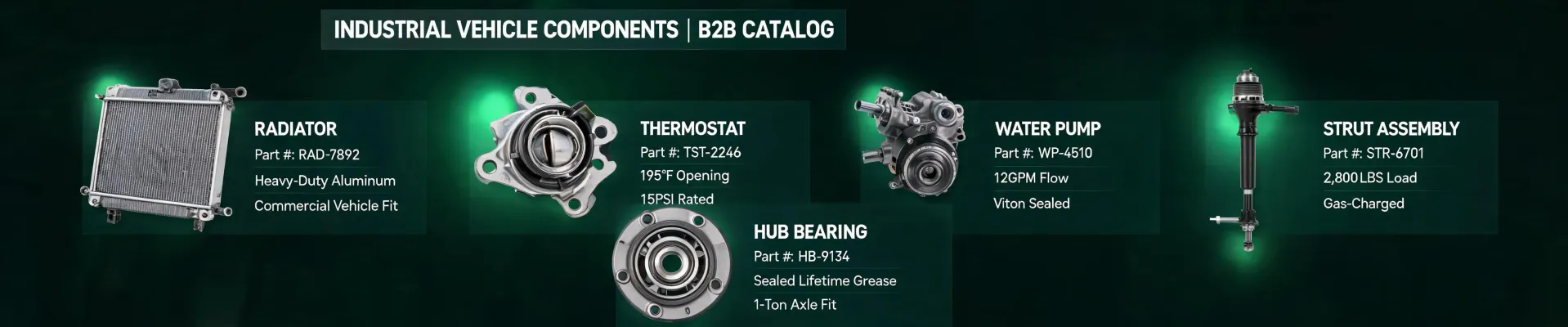
When someone searches for koyo wheel bearing and hub assembly, they usually mean factory-grade part without a dealer price. That's reasonable. But there's a trap: many hub assemblies are sold as OE replacement without being made in a Koyo plant.
In 2022, I ordered 25 equivalent hub units for a fleet job. The dimensions matched. The ABS rings looked identical. On the bench, all 25 worked. In the real world, two cars came back with intermittent ABS codes after about 1,000 miles. The sensor ring gap was off by roughly 0.3 mm. Not enough for a caliper to complain about, but enough for the sensor signal to drop at low speed. We didn't expect that. The spec sheet said compatible with OE.
This is where the process matters. A Koyo wheel bearing and hub assembly has the sensor ring controlled for concentricity and the seal selected for the wheel environment. A generic hub can use a decent bearing and still have inconsistent clamp load. It rolls fine in the box. It gets noisy at 8,000 miles. Not always, but more often than I'm comfortable with.
Conclusion: for a hub unit that needs to last beyond the warranty period, I wouldn't choose the cheapest hub with the same part number. The dollar gap is smaller than the cost of a comeback. Expensive lesson, but workable.
2. IS300 Koyo Radiator vs 'Like Koyo' Aluminum
Next, the IS300 Koyo radiator. This is a popular search term because the factory plastic-tank radiators crack at the tank seam. Koyo aluminum radiators are a clean replacement. With popularity comes lookalikes.
Once, a coworker bought a 'works like Koyo' radiator for a salvage-rebuild IS300. Overall dimensions were the same. The core was thinner. The fin count was lower. The car didn't overheat immediately. It ran hotter under load, and the upper hose fitting looked like it was welded by someone in a hurry.
I should add: I don't have a lab test to show you. What I have is a teardown checklist. If the core is 12% thinner, the radiator cannot shed the same heat at highway speed. If the hose fitting isn't radiused the same, the clamp can cut the silicone hose.
On an IS300, the Koyo radiator's value is that it's a designed aluminum radiator, not a generic universal core with brackets welded to approximate locations. The brackets line up because the core dimensions are controlled. That matters more than the polished finish.
Conclusion: for a stock or lightly modified IS300, I'd buy the IS300 Koyo radiator over a lookalike. If you're building a high-horsepower custom system, buy a custom radiator. But don't buy a visible imitation and call it a Koyo.
3. Canopy Air Filter: Where Brand Is Less Important
Now the part where I push back on brand loyalty: the canopy air filter. A canopy air filter on a tractor, sprayer, or mining equipment cab doesn't need to be expensive. It needs the right sealing edge, the right media, and a frame that won't collapse under normal delta pressure.
It's tempting to think an air filter is just folds of paper. The complexity is the gasket. One year I ordered 200 canopy air filters based on part number. The media was right. The gasket was softer than the original. In an environment with oil mist, the gasket swelled and shifted. The seal didn't fail in the first week. It failed at 200 hours, and dust showed up inside the intake.
My experience here is based on equipment in the 100 to 250 horsepower range. If you're in a mining or desert environment, filter media and service intervals will be different.
Should you buy Koyo for this? Koyo doesn't make air filters, as far as I know. That's the point: the best supplier depends on the failure mode. For bearings, Koyo. For a canopy air filter, a filter specialist with a published test standard.
Conclusion: brand matters less when the failure is visible and measurable. Choose by seal and media data.
4. Gold Brake Pad: Color Is Marketing, Not a Spec
The next search term is gold brake pad. There are legitimate gold-colored brake pads from known friction brands. And there are brake pads with a gold coating that says nothing about the friction material.
Per FTC guidelines (ftc.gov), performance claims on brake parts must be truthful and substantiated. A colored backing plate is not a performance claim. If the package says gold but no friction code, no temperature range, and no OE reference, that's a red flag.
At our shop, we tested a cheap gold-coated pad. The pedal felt fine cold. After a long downhill run, the pedal went soft. The friction material had faded, and the gold coating had burned off in the center. The pad had no thermal rating printed on it.
Does that mean all gold brake pads are bad? No. It means the color is not why you buy them. Pick a pad by duty cycle, then check the claim. If a customer asks for the gold brake pad, ask first: street, towing, or track? The answer decides the friction spec.
Conclusion: a gold brake pad can be a good pad, but only if the data sheet earns it.
5. Does Your Alternator Charge Your Battery? Yes, but Not Like a Charger
One more comparison that every repair shop has faced: does your alternator charge your battery? Yes, the alternator charges while the engine runs. But charge is not the same as revive. A deeply discharged battery with a dead cell cannot be repaired by an alternator. It will keep pulling current, heat up, and stress the output diodes.
One of my logged mistakes involved an alternator bearing. We diagnosed a noisy alternator, pressed in a new Koyo bearing, tested output—14.1 volts at idle. The battery still read 12.3 volts after a 30-minute drive. I could have blamed the alternator. The real issue was a shorted cell. The alternator was fine.
So the comparison is not alternator vs battery. It's diagnosis vs parts shotgun. A voltage reading of 12.3 volts is not a charged battery. Load test first, then replace the part that actually failed.
Conclusion: if someone asks whether the alternator charges the battery, the answer is likely yes, but the battery has to be able to accept the charge.
What I'd Buy Today
Five years ago, I was more willing to roll the dice on no-name hubs. I'm not anymore. The failure data changed my system. But that doesn't mean every aftermarket part is bad, or that Koyo is right for everything. It means the comparison should be based on evidence, not on a logo or a color.
- Wheel hub assembly: for Japanese OEM and fleet work, a Koyo wheel bearing and hub assembly is a defensible default. Compare it to the cost of a comeback, not just the unit price.
- IS300 radiator: for stock or lightly modified cars, use the IS300 Koyo radiator. For custom builds, do the core-volume and mounting math yourself.
- Canopy air filter: choose by seal, media, and dust-holding capacity. The brand should be a shortcut, not the whole spec.
- Brake pads: choose by friction class and temperature range. A gold brake pad is fine if the data sheet says so.
- Alternator vs battery: check the battery first. The answer to does your alternator charge your battery is probably yes, unless the battery can't hold the charge.
These conclusions come from 14 mistakes in my own order history. They're not universal. If you work in racing, mining, or heavy commercial fleets, some of this will shift. The fundamentals haven't changed: traceable process, honest claims, and a part that does the job beyond the first week.
Not ideal? It's better than what I used to do.

Elise Novak
Elise Novak is an automotive braking systems analyst specializing in brake pads, discs, rotors, calipers, shoes, drums, hoses, and complete brake kits. She uses UN Regulation 90 requirements and ISO 26867 dynamometer methods to examine friction stability, fade and recovery, wear, disc thickness variation, runout, and hydraulic integrity. Her work helps distributors, quality teams, and fleet buyers compare replacement parts, verify application suitability, and define incoming-inspection criteria.