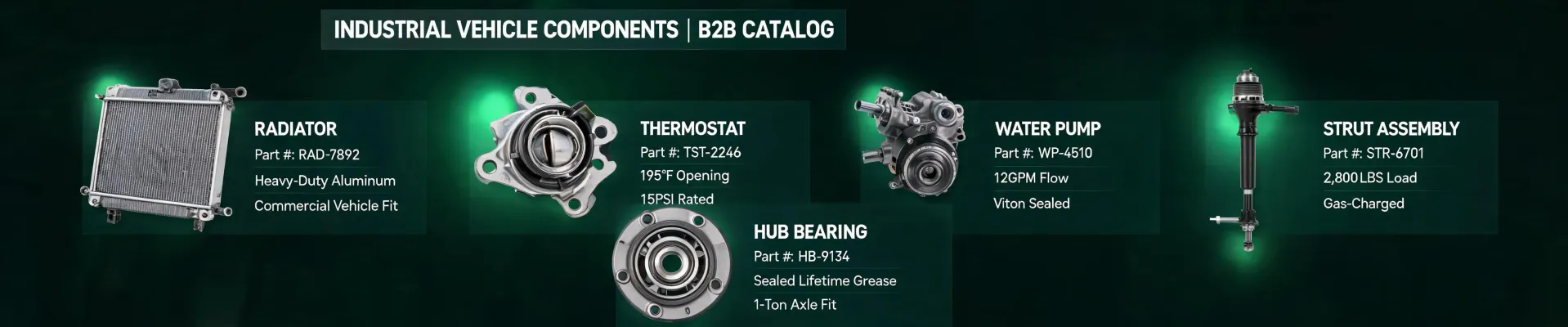
If you're replacing the radiator in a daily-driven Mazda Miata, a genuine Miata Koyo radiator is worth the premium. I've spent four years as a quality compliance inspector at an automotive parts manufacturer, reviewing roughly 200 unique parts a year, and the failure data on budget radiators is unambiguous. Cheap units fail at a rate that makes the Koyo price difference a rational decision, not a luxury. I've rejected nearly 9% of first shipments from suppliers in the past year alone—and most of those defects were invisible to the naked eye.
I'm not here to tell you that Koyo is the only brand worth buying. I'm telling you that "you get what you pay for" is real, measurable, and especially true for cooling system parts. Here's the reasoning, the data, and the caveats.
The "It's Just a Radiator" Trap
It's tempting to think a radiator is a simple part: two tanks, a finned core, a pressure cap. How different can brands actually be? I used to think that too, until we ran a blind comparison between a genuine Koyo and a budget alternative for the same Miata application. The budget unit was roughly 30% cheaper and the flow specs looked comparable. But under sustained heat load, the budget core reached its saturation point about 8°C earlier. On a hot summer day or a track session, that's the difference between a stable gauge and pulling over to let it cool down.
That's the oversimplification trap: "spec-compliant" does not mean "performs the same." Fin density, tube wall thickness, header-to-tank joint design, and alloy selection are engineering choices that don't appear on the product page. They show up under load.
What Buyers Miss (And What I Inspect)
Most buyers focus on core thickness and clean welds. Both matter, but the failures I see most often come from things nobody looks at:
- Fin-to-tube contact. If the fins aren't fully seated against the tubes during brazing, heat transfer drops 15–20%. This is invisible from the outside, but it shows up immediately in a thermal performance test.
- Pressure consistency. IATF 16949-certified quality plants routinely sample radiators at 2x rated working pressure. In our audits, budget units from unidentified plants fail at 1.3–1.5x. That's a direct measure of design margin.
- Thread and port tolerances. A 0.5mm thread pitch mismatch on a drain plug is one of the most common causes of "leaked on day one." Quality manufacturers hold these to roughly ±0.1mm.
- Alloy grade. In my first year, I made the classic rookie specification error: I approved a batch based on a drawing that said "aluminum" without specifying the alloy family. The supplier used a softer grade for the tanks, and thermal cycling caused micro-cracking around the welds. We scrapped eighty units—a $12,000 mistake. It was also a communication failure: I'd said "production quality," they'd heard "the cheapest aluminum that passes a visual check." Now every contract specifies the exact alloy series and references the applicable material standard.
There's also a nuance specific to a Koyo tucked radiator setup. Tucking the radiator lower changes the coolant bleed path and the pressure cap's position relative to the highest point in the system. That's not a defect in the radiator—it's an installation variable. You'll need a proper bleed procedure, or you'll chase mysterious overheating that has nothing to do with the part itself. I've seen this come up in both street builds and track cars.
Auxiliary Water Pumps: The Hidden Quality Gap
Here's an outsider blind spot: owners will spend a thousand dollars on a cooling system upgrade and leave an aging auxiliary water pump in place. Then the pump dies eighteen months later, the car overheats at the worst possible moment, and the repair bill wipes out any savings from the original bargain.
The quality gap in these pumps is measurable. I've verified impeller-to-housing clearance at 0.1mm or better in quality units; budget units measure up to 0.8mm. That means lower flow at idle, reduced head pressure when the engine is off, and a whine that gets louder as the bearing wears. You won't spot it on a shelf. You can only catch it with dial calipers and a test bench.
Heat Pump vs AC Condenser: Same Lesson, Different Parts
The heat pump vs AC condenser question comes up more now that EVs are common. They're both heat exchangers, but they do different jobs. An AC condenser rejects heat from the refrigerant loop to cool the cabin. A heat pump reverses the cycle to move heat into the cabin when temperatures drop. In cold climates, a heat pump is substantially more efficient than resistive heating—which is why it's become the standard in modern EVs.
From a parts quality perspective, the lesson is identical: these are high-pressure, high-temperature components with very little tolerance for manufacturing shortcuts. A pinhole leak in a condenser's micro-channel silently vents refrigerant until the system stops cooling. The diagnosis and labor cost almost always exceeds the price difference between a quality condenser and a cheap one.
It's Not Just Cooling Parts
This pattern repeats across every component category I inspect. Take a Jeep Wrangler turn signal, for example. Cheap housings aren't properly sealed, condensation forms inside the lens, and the reflector dulls within a year. It's a small part with a small price gap—but the annoyance and safety impact make the quality version objectively better. The same logic applies to radiator caps, thermostats, coolant hoses, and even trim clips. Quality failures concentrate at the low end of the price spectrum.
The Real Cost of "Probably Fine"
Now for the part that isn't about engineering at all: the cost of uncertainty. When you're up against a deadline—a race weekend, a restoration target, or a daily driver that has to be back on the road by Monday—paying for delivery certainty isn't a luxury. You're not paying for faster shipping. You're paying to reduce the probability of failure, and that reduction has a real dollar value.
In March 2024, a customer chose a lower-cost supplier over a quality-oriented one for a batch of race radiators because the cheaper lead time fit their schedule. The shipment arrived five days late, and two units failed pressure testing on arrival. The race program lost a test day, the rework cost more than the savings, and the "on-time cheap" option became the most expensive one in hindsight. I've watched this play out every quarter since I started this job.
To put numbers on it: in Q1 2024, we compared four suppliers across ten parts categories. The quote spread for the same parts was about 40% from lowest to highest. But measured as cost per good part delivered on time—including delays, failures, and rework—the cheap suppliers ended up roughly 30% more expensive. The highest upfront quote was the lowest-cost option in real terms.
When a Budget Part Is Actually Fine
I want to be honest about the boundary conditions, because "always buy premium" is just as wrong as "always buy cheap." A budget radiator is a defensible choice if:
- The car is a weekend project, not a daily driver. A 3–4 year lifespan may be acceptable if the failure mode won't damage anything critical.
- You can inspect the part yourself. If you have the tools to pressure-test and verify fitment tolerances, you can make an informed call that the average buyer can't.
- The failure mode is mild. A failed turn signal housing is an annoyance. A failed radiator can destroy an engine. The cost of failure matters just as much as the probability.
And regardless of which radiator you settle on, verify fitment against your specific vehicle. I'm not 100% sure of every chassis variant's part number from memory—take your VIN or engine code and check the manufacturer's official fitment guide. Even the best brands have superseded revisions and compatibility quirks, especially for a tucked radiator installation where space is tight.
So the real takeaway isn't "Koyo is the only brand worth buying." It's that the cheapest part and the best part are rarely the same part. And when the failure mode is an overheated engine on the side of a highway, the cost of being wrong is far higher than the premium you were trying to save. Decide with the data in hand—not with the comforting assumption that "it's all the same metal box."

Elise Novak
Elise Novak is an automotive braking systems analyst specializing in brake pads, discs, rotors, calipers, shoes, drums, hoses, and complete brake kits. She uses UN Regulation 90 requirements and ISO 26867 dynamometer methods to examine friction stability, fade and recovery, wear, disc thickness variation, runout, and hydraulic integrity. Her work helps distributors, quality teams, and fleet buyers compare replacement parts, verify application suitability, and define incoming-inspection criteria.