-
Koyo Wheel Bearing vs. No-Name Bearing: The Price Gap Isn't the Real Cost
-
Koyo Radiator RSX 02-06 Part Number Comparison: The Fine Print
-
Water Well Pump House: Prefab vs. Site-Built
-
4-Inch Exhaust Pipe Diesel: Aluminized vs. Stainless Steel
-
Cataclean Fuel & Exhaust System Cleaner Reviews: A Cost Perspective
-
So What Do I Actually Recommend?
I'm a procurement manager at a 130-person fleet services company. I've tracked roughly $180,000 in parts and service invoices over the last six years, and I've built a simple rule around every purchasing decision: unit price is a terrible indicator of cost. In Q2 2024, we switched two vendors in our shop supply chain and cut our annual spend by about 17%, but that's a story for another post. This post walks through five comparisons I've dealt with—Koyo wheel bearings, RSX radiators, water well pump houses, 4-inch diesel exhaust, and Cataclean. Each one taught me something about total cost of ownership (TCO).
Let me put my bias on the table: I'd rather pay $80 for a part that lasts three years than $30 for the same part that fails in eight months. But I also won't pay $80 for a part where the $30 version is actually fine. That's the tension this article is about.
Koyo Wheel Bearing vs. No-Name Bearing: The Price Gap Isn't the Real Cost
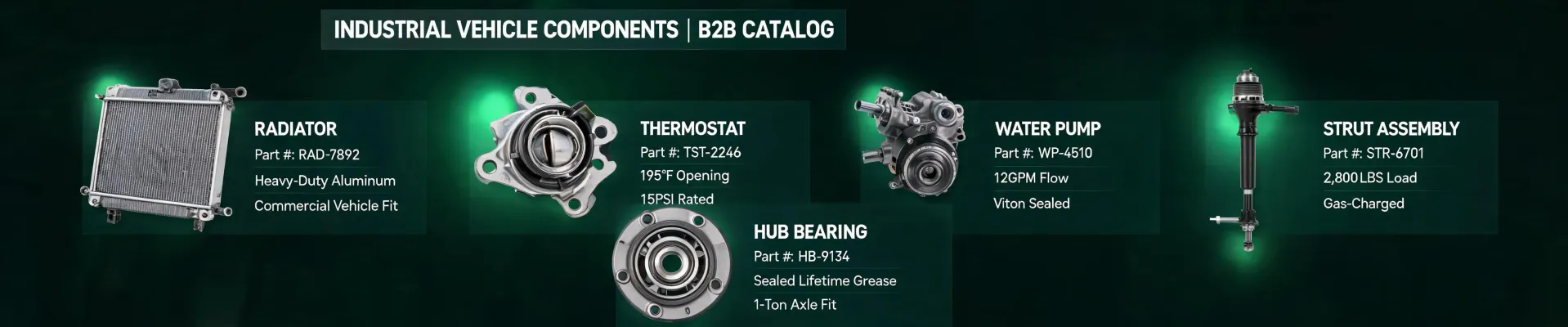
Koyo is an OE supplier, which means your car's factory bearing might literally be a Koyo. The no-name version of the same wheel bearing can be 30-50% cheaper on Amazon or RockAuto. I've been tempted. A few years ago, I approved a $23 'will fit' bearing for one of our service truck trailers. Three months later, the trailer came back with a growling hub. The replacement labor cost $190. Let's do the arithmetic: the no-name bearing was $23 plus $190 labor, so $213 for about three months of use. That's roughly $71 per month. A Koyo wheel bearing, at maybe $55 plus the same $190 labor, would run $245 total—and it should last two to three years. Cost per month: $8 to $20. The cheap part wasn't cheap by the time labor was included, and that doesn't count the downtime of the truck.
I'm not a mechanic, so I can't speak to metallurgy or seal design. What I can tell you from a procurement perspective is that safety-critical rotating parts have a much higher failure cost than their price tag suggests. That doesn't mean every no-name bearing is garbage—but in a TCO comparison, the cheap bearing needs a very good track record to beat a known OE supplier.
At least, that's been my experience with fleet buyers who factor in their own labor rates. For the record, we now keep a small stock of Koyo hub assemblies for our most common trucks, so we don't get tempted by the cheap listing when a truck is down.
Koyo Radiator RSX 02-06 Part Number Comparison: The Fine Print
This one still stings. The 2002-06 Acura RSX has at least a couple of Koyo radiator options depending on transmission (manual vs. automatic) and A/C config. I assumed 'same specs' meant identical results across part numbers. Didn't verify. Turned out the radiator I ordered had the wrong mounting tabs for the automatic cooler lines. I still kick myself for not spending 10 minutes on the Koyo catalog before pushing 'buy.' Dodged a bullet when the shop caught the mismatch before forcing it in—one more turn and it would have cracked the radiator.
The part number comparison isn't about Koyo vs. OEM here—it's Koyo vs. 'close enough.' The difference in total cost:
- Correct Koyo radiator: ~$200, one hour installation.
- 'Close enough' part: ~$160 plus return shipping, restocking fee, and a second teardown. Final cost: $270+ and an extra week of downtime.
So my honest advice: verify the part number against the VIN or a reputable parts diagram before ordering. This was accurate as of Q1 2025, but supersessions happen, so double-check current listings.
Water Well Pump House: Prefab vs. Site-Built
This isn't a car part, but it's the same comparison structure. For a water well pump house, prefab fiberglass or steel enclosures cost more upfront—often 20-40% more than lumber and materials for a site-built shed. But the site-built option has hidden costs: building permits, weather delays, wasted materials, and the fact that whoever builds it might not show up.
In 2023 we priced a site-built pump house at $2,200 in materials and $1,400 in labor, so $3,600 estimated. The prefab was $2,900 plus $600 delivery and about 4 hours to place. Total roughly $3,700. The site-built version ended up taking five days instead of two because of weather, and we had to rent a temporary pump cover in the meantime. Final outlay: $4,300. Here's the counterintuitive one: the prefab won on total cost because the installation labor was predictable.
General rule (I'm a buyer, not a builder): the less control you have over the construction timeline, the more the prefab premium pays for itself.
4-Inch Exhaust Pipe Diesel: Aluminized vs. Stainless Steel
For a 4'' exhaust pipe diesel, the standard comparison is aluminized steel vs. stainless steel. Stainless costs 40-60% more and resists corrosion far better. Aluminized steel rusts eventually—especially if you're in a salt-belt state or hauling near chemical environments. For a 4-inch pipe, you might pay $180 for aluminized and $300 for stainless.
Here's the TCO twist: if your truck's average working life is, say, 6 years and you're in a dry climate, the aluminized pipe may never rust out before the truck is retired. I've seen stainless exhaust upgrades that were pure performance vanity on trucks that should have been sold two years earlier. Conversely, if this is a diesel you expect to run for 15 years, stainless is the lower annual cost almost every time.
So the honest answer: it depends on your environment and replacement cycle. Don't let a muffler shop upsell you into stainless if the truck's remaining useful life doesn't justify it.
Cataclean Fuel & Exhaust System Cleaner Reviews: A Cost Perspective
Cataclean is one of those fuel additives that claims to clean the fuel system, catalytic converter, and oxygen sensors. Read the reviews and you'll see plenty of 'it cleared my check engine light!' alongside a fair number of 'did nothing.' Both are probably true. In Q2 2024, we tested Cataclean on five trucks that had O2 sensor-related codes. Two cleared after a tank of fuel. Three didn't. That's a small sample, but it tracks with the reviews: it helps on light carbon buildup, not mechanical faults.
Per FTC guidelines (ftc.gov), advertising claims have to be truthful and substantiated. Cataclean's claims are more modest than the marketing implies—it can help with light carbon buildup, but it is not a fix for a failed catalytic converter or a mechanical fault. From a cost standpoint, a $30 bottle is worth trying once or twice. It is not worth a third bottle when the first two didn't work. I want to say we've spent about $320 on 'maybe it works' additives over the years, though I might be misremembering the exact figure.
What I can tell you from order data: a catalytic converter replacement on a heavy-duty truck runs $1,200-$2,800. Cataclean is $30-$40. That math makes sense at first. But if the underlying problem is mechanical, every additive bottle is just delaying the real repair ticket—and extended driving with a bad converter can damage other components, turning a $1,500 job into a $3,000 one.
So What Do I Actually Recommend?
No universal 'buy this, not that' answer here, but here's my scenario-based summary:
- Koyo wheel bearings: If it's a safety-critical hub, choose Koyo or another known OE supplier. For low-speed trailers and non-critical spindles, the cheap bearing is worth the gamble.
- RSX radiator part numbers: Always verify the exact Koyo part number for your RSX 02-06 configuration before ordering. The 'good deal' radiator is only good if it can be installed.
- Water well pump house: If you need it done before a freeze or project deadline, prefab wins on total cost. If you have a reliable builder and no deadline, site-built is fine.
- 4'' diesel exhaust: Stainless if you're in a corrosive environment or keeping the truck past 10 years. Aluminized if you're in a dry climate and the truck will be sold before it rusts.
- Cataclean: Use it for light carbon-related misfires or O2 sensor codes. If it doesn't work in one or two tanks, spend the money on a real diagnostic.
I'll be the first to say none of this is universal. Your labor rates, vehicle age, and risk tolerance will change the math. But the comparison framework—unit price vs. total cost—has never let me down. It's saved me far more than the $180,000 I've spent, and it only cost me one embarrassing radiator return to learn.

Elise Novak
Elise Novak is an automotive braking systems analyst specializing in brake pads, discs, rotors, calipers, shoes, drums, hoses, and complete brake kits. She uses UN Regulation 90 requirements and ISO 26867 dynamometer methods to examine friction stability, fade and recovery, wear, disc thickness variation, runout, and hydraulic integrity. Her work helps distributors, quality teams, and fleet buyers compare replacement parts, verify application suitability, and define incoming-inspection criteria.