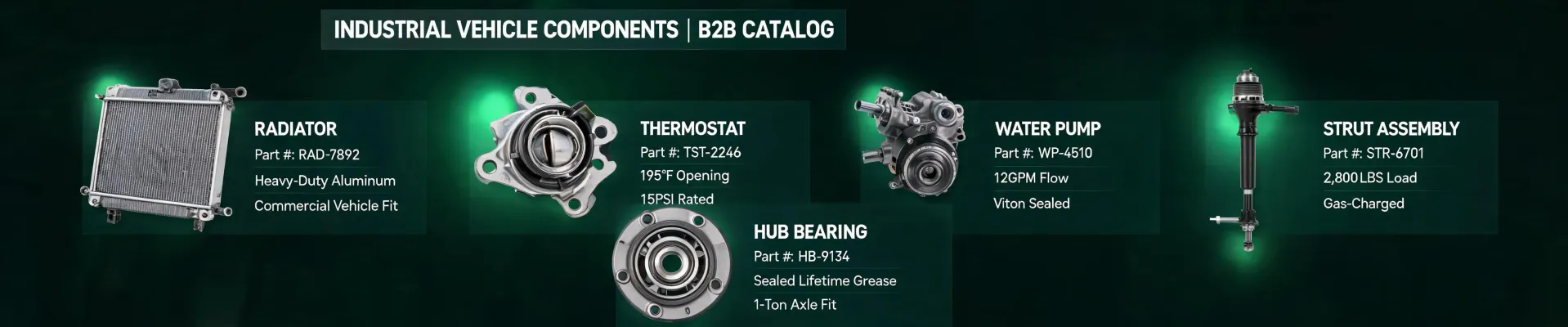
If I had to compress my years of parts procurement into one sentence: Buy the exact Koyo radiator for your Lexus IS300 or Honda S2000, replace the radiator cap at the same time, torque new SBC flywheel bolts to spec, and never assume the serpentine belt is the same as the timing belt. That single habit has saved me more money than any bulk discount I've ever negotiated.
I'm a procurement manager at a 40-person repair shop, and I've handled about $180,000 in annual parts spending for the last six years. I've processed over 1,200 purchase orders—maybe 1,300 now, I'd have to check—compared quotes from 30-plus vendors, and documented every part failure that came back on a customer invoice. This article is what that data taught me.
Why the Right Koyo Radiator Matters
The Koyo radiator IS300 and Koyo radiator S2000 are both aluminum replacement radiators, but they are not the same unit. The IS300 version is laid out for the 2JZ-GE engine bay. The S2000 version is shaped around the F20C. Different inlet and outlet positions, different core widths, different mounting points. The internet can tell you to just "make it fit", but the internet doesn't pay for returns.
I remember one job where I had two hours to order a radiator for an IS300 customer. Normally I'd compare three vendors and check stock. No time. I went with the Koyo radiator IS300 part number from our last good order because I knew the fitment was right. That's the value of a known part number: it lets you make a fast decision without gambling.
Koyo's official catalog as of January 2025 still lists distinct radiators for the IS300 and the S2000. The prices vary by model and core type. Verify current pricing at your distributor because suppliers change rates quickly.
There's a recurring pattern in my invoice history: a buyer chooses a lower-priced radiator because the initial quote looks better. After shipping, return fees, and a second round of labor, the final invoice was higher than the Koyo part would have cost upfront. I build a simple cost calculator for common orders, and it includes returns and redo labor, not just the sticker price.
In the radiator orders I've tracked, Koyo units consistently had better fitment details than generic imports: mounting tabs lined up, drain plug placement was right, fin density was even. That may sound minor until you've spent an afternoon fighting a radiator that is close but not exact.
The SBC Flywheel Bolt Lesson That Cost Me Real Money
I only believed SBC flywheel bolts are one-time-use after ignoring the warning once. The bolts looked fine. No fretting, no rust, no visible stretch. I reused them. That build came back about 1,000 miles later with one bolt backed out. It scored the flywheel, nicked the bellhousing, and added $400 to the job. The replacement fasteners were $25. Never again.
SBC flywheel bolts are typically SAE J429 Grade 8, and most factory service manuals say to install new ones at assembly. Torque spec is usually in the 65-75 ft-lbs range for small block Chevy flywheels, but verify your year and application. The lesson is simple: new SBC flywheel bolts are cheap insurance against a very expensive comeback.
I now keep a small bin of new SBC flywheel bolts in stock. It costs maybe $50 to have ten sets on the shelf. That one bin has saved us more comebacks than almost any other inventory decision I've made.
The Radiator Cap: The $10 Part That Gets Ignored
The radiator cap is the most ignored part on a cooling system. It's not a lid. It's a pressure regulator. If you search "cap radiator" on any parts website, you'll get dozens of options, and a lot of them look identical. But the pressure rating and venting behavior matter. A cap that holds too little pressure lets coolant boil earlier. One that holds too much stresses hoses, clamps, and the radiator tank itself.
When I ordered two Koyo radiator S2000 units for a customer last year, I added matching caps because the existing caps were over ten years old. One held pressure; the other didn't. They looked the same sitting on the bench. The cap was the failure point waiting to happen, not the radiator.
The cap is also part of the cooling system's pressure loop. On a Koyo radiator, the seal surface and neck depth are designed around a specific cap. If the cap doesn't seat right, the system can draw air in during cool-down. That's how you get mysterious air pockets that lead to hot spots.
Is the Serpentine Belt the Same as the Timing Belt? No.
Is the serpentine belt the same as the timing belt? No. I'll say it louder for the people in the back: no. The serpentine belt is the external belt that drives the alternator, power steering pump, and air conditioning compressor. The timing belt is inside the timing cover and synchronizes the crankshaft and camshafts. If the serpentine belt snaps, you lose steering assist and charging, but the engine keeps rotating. If the timing belt snaps on an interference engine, pistons can hit valves and end the engine's life.
From a procurement standpoint, they're not even in the same line item. A serpentine belt is a single-part replacement. A timing belt service is a kit: belt, tensioner, idler, and often a water pump if you're already in there. And the S2000? It doesn't have a timing belt at all. The F20C engine uses a timing chain. So when someone asks is the serpentine belt the same as the timing belt, the correct answer is no, and the second question has to be "which engine are we talking about?"
Based on the invoices I've processed, a serpentine belt replacement for an IS300 ran us around $52 for the belt plus an hour of labor. A timing belt kit, including tensioner and idler, was roughly $180 in parts before installation. Add a water pump and that number climbs. When customers ask for a "belt job," I always clarify which belt. They are different budgets entirely.
The Part List I Keep Coming Back To
- Koyo radiator IS300 (model-specific part number) with matching radiator cap
- Koyo radiator S2000 (model-specific part number) with matching radiator cap
- New SBC flywheel bolts, Grade 8 or equivalent, not reused
- Correct serpentine belt for the accessory layout, not a "universal" one
- Timing belt kit if the IS300 is due—separate from the serpentine belt
That list looks boring. That's the point. When I audit our shop invoices, these are the items that cut down comebacks.
When This Advice Doesn't Apply
Now for the boundaries. If your IS300 is a turbo track build or your S2000 is heavily modified, the standard Koyo replacement might not be the right unit. High-power cars often need a larger core, extra oil cooling, or custom routing. And if you're building a race-only SBC, aftermarket flywheel bolts may have different torque requirements. I'm a cost-control guy, not a design engineer. You still need the factory service manual and Koyo's official catalog for part verification.
Small Orders Become Big Accounts
One last thing. If you're buying one Koyo radiator and a cap for a weekend project, don't let a vendor make you feel small. I've been in this business long enough to watch single-part customers become fleet accounts. In my experience, the person who orders a Koyo radiator S2000 part today is the person who puts one on every car in the shop next year. Small doesn't mean unimportant. It means potential.
Buy the right part, install it like the bolts are the only thing holding the engine together, and never trust a belt diagram from memory.

Elise Novak
Elise Novak is an automotive braking systems analyst specializing in brake pads, discs, rotors, calipers, shoes, drums, hoses, and complete brake kits. She uses UN Regulation 90 requirements and ISO 26867 dynamometer methods to examine friction stability, fade and recovery, wear, disc thickness variation, runout, and hydraulic integrity. Her work helps distributors, quality teams, and fleet buyers compare replacement parts, verify application suitability, and define incoming-inspection criteria.