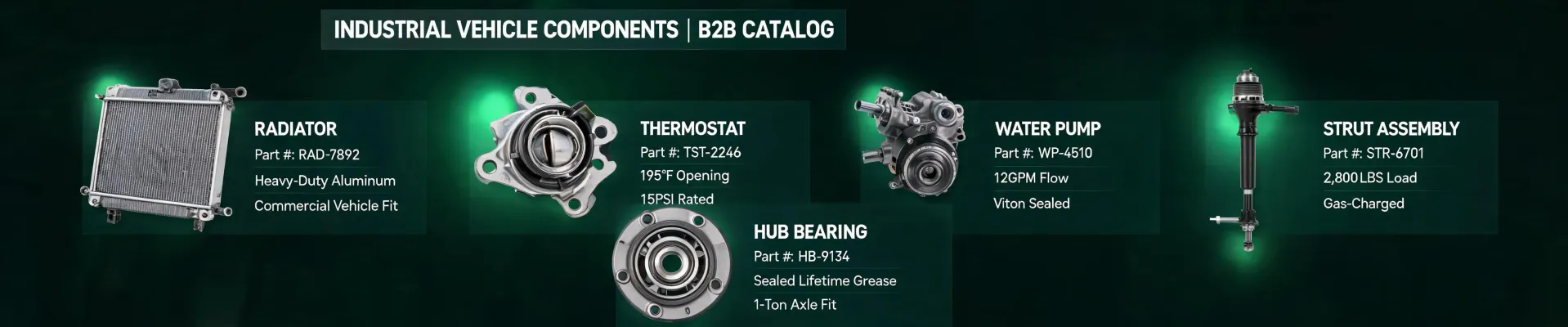
Here's the conclusion up front: Never judge an automotive part by the photo—judge it by the print. The part that looks perfect in a listing can be the same part that fails three months later. That's true for a radiator, a wheel bearing, a brake bleeder repair kit, and even a piece of yellow headlight tint.
I'm a quality/compliance manager at Koyo, an automotive parts manufacturer. I review roughly 200 unique part numbers a year—from stamped brackets to progressive dies. In Q1 2025, I rejected 9% of first deliveries. Not because the parts were visibly broken. Most looked fine. They failed because they didn't meet a written specification: dimensions, material certs, heat treat records, surface finish.
If you take away one thing from this article, let it be this: always get the specification in writing before you place an order. Then make sure the supplier proves they met it. That applies to a $2 brake bleeder repair kit and a $2,000 Koyo radiator alike.
Why I ended up on this side of the table
Before Koyo, I spent four years on the customer side. I was the one who had to tell a plant manager that a shipment of stamped components didn't match the drawing—and then watch the line stop. That experience shaped how I think about quality today.
It took me four years and roughly 150 supplier audits to understand that good quality isn't about perfect parts. It's about controlled variation. One part can be within tolerance by luck. A hundred parts in a row that stay within tolerance mean the process is stable. That's the difference.
Another lesson: the numbers said approve a supplier—good price, quick lead times. My gut said something was off. It turned out their quality documents were copied from another factory. I trust the gut now, but only after the paperwork.
At Koyo, we combine stamping, forging, aluminum extrusions, and CNC machining in-house. That matters because it gives us one source of truth when something goes wrong. We can trace a burr back to a worn progressive die instead of pointing fingers at three different subcontractors.
What I check before a small order ships
Most of our customers are OEMs and tier-one suppliers. But we also take small orders. That's not just policy—it's experience. When I was starting out, the vendors who treated my $200 orders seriously are the ones I still use for $20,000 orders. Small doesn't mean unimportant. It means potential.
Koyo radiators
When buyers search for Koyo radiators, they usually want to know if one will cool their engine reliably. The quality check starts with core thickness, fin density, and tube wall thickness. A radiator that's 10% thinner than spec might pass a bench test and still overheat under summer load. We also check brazing records, not just pressure test results. The link between a radiator and an aluminum extrusion is real: even the tank material has to meet an alloy spec.
Koyo wheel bearings
Wheel bearings are a quieter failure—until they aren't. For Koyo wheel bearings, the specs that matter most are race hardness and internal clearance. A bearing can look perfect and still have the wrong preload. If a supplier can't provide heat treat certificates, that's a red flag. I'd rather wait a week for documentation than approve a part by feel.
Brake bleeder repair kit
A brake bleeder repair kit is small, simple, and easy to overlook. But if the seat angle is off by half a degree, it can pull air into the brake system. That's not a minor inconvenience—it's a safety issue. We check thread form, seat angle, and plating thickness on every kit. It's one of those parts where cost doesn't equal importance.
Yellow headlight tint
Yellow headlight tint feels like a cosmetic product, but it has a safety role. If the adhesive isn't UV-stable, the film peels, the lens gets patchy, and the beam scatters. According to the FTC (ftc.gov), advertising claims must be truthful and backed by evidence. We apply the same standard to our own materials: if a film doesn't pass UV testing, we don't call it durable.
Why does my thermostat say aux heat?
Yes, this article might show up for the search 'why does my thermostat say aux heat.' That's an HVAC question, not a car part question. But the mindset carries over. Aux heat means the system is using a backup heat source because the primary one can't keep up. In a vehicle, a stuck-open thermostat creates a similar 'system isn't operating as expected' situation—except the backup source is your engine overheating. That's why we test thermostats on a thermal response curve, not just at one opening temperature.
The cheap part is the one that keeps me up at night
Here's the thing that surprises most buyers: the part I worry about most isn't the complex, expensive one. It's the cheap one that sits in a safety system for years. A brake bleeder screw is a few grams of steel. If it fails, the whole brake system fails. That's why I'm more concerned about a $2 component than a $200 trim piece. Simple.
That's also why I have mixed feelings about minimum order quantities that are designed to push small buyers away. I get the economics—small orders don't amortize tooling. But a small order doesn't need to be a low-quality order. A sample of fifty parts gets the same first article measurement report as a fifty-thousand-piece run. The setup cost is the same. The drawing is the same. The risk is the same.
Small doesn't mean sloppy. Period.
I still kick myself for accepting a vendor's verbal assurance about material hardness on a small order. If I'd required the mill cert, we would have caught the issue before it became a $22,000 rework. That lesson stuck: small order, same documentation requirements.
When this doesn't apply
Now the honest boundaries. Not every part needs the same level of inspection. A yellow headlight tint that peels is annoying; a wheel bearing that fails is dangerous. So I'm not saying to spec every cosmetic part like a safety component. I'm saying you should define the spec based on risk—and then enforce it.
And if a supplier says 'it's within industry standard' but can't show you the number, that's not an industry standard. That's an excuse. That said, I've also seen buyers demand impossible tolerances for parts that didn't need them. The best spec is the one that fits the function, not the tightest tolerance the factory can brag about.
For small buyers especially, don't accept sloppy service. But also don't expect small-order pricing to match large-order pricing—setups are real. Expect honesty, documentation, and a supplier who treats your first order like a relationship, not a favor.
That's the standard we aim for at Koyo. It's not flashy. It's not flexible. And it's exactly what you want from a part you can't afford to fail.

Elise Novak
Elise Novak is an automotive braking systems analyst specializing in brake pads, discs, rotors, calipers, shoes, drums, hoses, and complete brake kits. She uses UN Regulation 90 requirements and ISO 26867 dynamometer methods to examine friction stability, fade and recovery, wear, disc thickness variation, runout, and hydraulic integrity. Her work helps distributors, quality teams, and fleet buyers compare replacement parts, verify application suitability, and define incoming-inspection criteria.