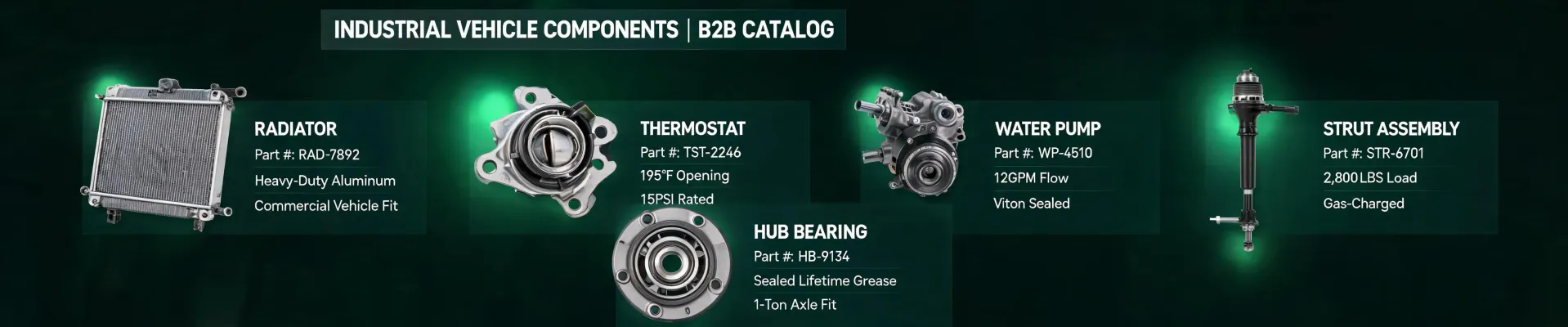
Look, if you ask 'how much is it to replace a wheel bearing,' you'll get a number fast. $260. $450. $900, if the bearing seizes on a 4WD spindle. The truth is, the number depends on your situation, and pretending there's one universal answer would be misleading.
I'm a quality engineer at an automotive metal-forming and precision machining manufacturer. I review roughly 200 unique part numbers a year before they ship. In 2024, I rejected about 7% of first-article samples—mostly for dimensions, not material grade. I don't work in a repair shop, so I can't tell you how to press a hub without damaging it. But I can tell you why parts fail, and whether a quality Koyo wheel bearing and hub assembly is worth the money.
Basically, there are three different readers asking this question. The answer differs for each.
Scenario one: you own the vehicle. You need one repair done right, ideally not repeated.
Scenario two: you run a shop or a fleet. You buy parts repeatedly, and every comeback cuts into margin.
Scenario three: you're an OEM specifier. You aren't paying an hourly labor rate; you're paying warranty costs and reputation costs across thousands of units.
How much is it to replace a wheel bearing? A realistic range
Published repair-estimator sites like RepairPal, as of early 2025, put most wheel bearing and hub assembly replacements on passenger cars and SUVs between $200 and $450 per wheel, parts and labor included. Some trucks run higher. Some Euro SUVs run much higher. And if the bearing fails completely before you get to the shop, the number can jump past $1,000 when a spindle or knuckle is damaged.
That estimate assumes you're replacing a noisy bearing, not a destroyed one. A humming bearing is annoying; a seized bearing turns a two-hour job into a two-day job. So yes, the 'wait until it gets really bad' approach is actually the most expensive approach.
Situation 1: You're a vehicle owner
If the bearing is humming, first confirm the diagnosis rather than just buying parts. A wheel bearing noise usually changes when you steer left or right—it gets louder when the failed bearing is loaded. If you're not sure, a good shop can confirm it with a load tester or by lifting the wheel and checking for play.
Once it's confirmed, choose the complete Koyo wheel bearing and hub assembly. Why complete? Because the hub assembly bolts on without a press, keeps the ABS tone ring protected, and includes the hub flange as one unit. Pressing a bare bearing into a rusted knuckle can be done right, but it leaves more room for installation error. For most modern vehicles, the assembly route is the one that gets the customer back on the road without a comeback.
Here's where my experience goes against common advice: you don't always need to replace both sides. Many sources say 'do both,' but if the opposite bearing shows no play, no noise, and no roughness, leave it. I've seen plenty of original bearings with 120,000 miles still within spec. Selling an unneeded bearing is the kind of thing that hurts a shop's reputation later.
While the vehicle is on the lift, check the steering rack. If you're getting clunks over bumps or the steering feels loose, the rack may be next. Replacing a worn Koyo steering rack is not cheap, but neither is paying for an alignment and then needing a second alignment after a rack replacement. If the rack is questionable, quote it while the car is already apart.
Situation 2: You're a shop owner or fleet buyer
For you, the real cost is comebacks. A $70 no-name hub assembly can fail in 20,000 miles, and when it does, the customer doesn't complain to the part manufacturer. They complain to you, on a Saturday, and they write a one-star review. That's brand perception, and no part price can fix it.
When I receive a new hub assembly for inspection, the first thing I look at is the wheel mounting face. It has to be flat and clean. Next, the studs—are they straight in the flange? Then the ABS tone ring—if it's exposed or poorly attached, it will be damaged in shipping or trigger codes later. I've rejected parts for all of those reasons.
The same thinking applies to other common replacements.
Take the 2016 Silverado thermostat. It's a small part, but its failure mode matters: fail closed and you overheat the engine; fail open and the engine runs cold, the heater underperforms, and fuel mileage drops. When buying a thermostat for a 2016 Silverado, verify the opening temperature specification and the gasket design. 'Looks close enough' isn't a quality plan.
The H4651 headlight is a different story. It's a sealed-beam headlamp, commonly found in older trucks and off-road vehicles. The part price isn't huge, but the labor is if the lamp is buried behind a grille. The quality difference shows up in beam focus: a cheap H4651 can produce a scattered pattern that doesn't light the road. I can't measure every headlight here, but if a supplier can't show you photometry data, question the part.
For a shop, this is my suggestion: bearings and steering racks go in the 'choose quality first' category. Thermostats get spec verification. Sealed-beam headlights get tested or purchased from a known source. The common thread is not assuming that a cheaper part is the same part.
Situation 3: You're a spec engineer or OEM buyer
When I talk to engineering customers, the issue isn't repair cost—it's warranty cost. A bearing failure in production doesn't just cost a replacement. It costs a flatbed truck, a rental car, a service advisor's time, and a customer who might walk for good.
That's why integrated metal forming matters. At Koyo, we handle stamping, forging, aluminum extrusion, and CNC machining in-house, which means we control dimensional consistency from raw material to finished hub. A wheel bearing and hub assembly is a stack of precision components: flange, races, rollers, seals, and tone ring. If one of them is off, the whole unit fails early.
A steering rack is no different. A Koyo steering rack needs correct mounting points, pressure specs, and sealing. 'Good enough' shows up later as steering wheel play or uneven tire wear. When specifying, look for IATF 16949 certification and ask for PPAP data on critical dimensions—Cpk values, not just 'within tolerance.' The parts that perform on paper also tend to perform at mile 50,000.
How to tell which scenario you're in
If you're here because a wheel bearing is humming on your own vehicle, you're situation 1. Get a proper diagnosis, buy a quality Koyo wheel bearing and hub assembly, and don't let a cheap price talk you into doing the job twice. Replacing a wheel bearing twice is not a bargain. It's two labor bills and one lesson.
If you're stocking shelves, quoting jobs, or purchasing for a fleet, you're situation 2. Compare total cost—part price plus comeback risk plus customer trust. The $350 job that never comes back beats the $250 job that comes back with a tow truck.
If you're writing a bill of materials, you're situation 3. Ask for evidence. Check the manufacturing process, the quality system, and the parts that have already failed. Then decide.
Bottom line: there isn't one answer to 'how much is it to replace a wheel bearing.' There's a range, a set of quality decisions, and a reputation consequence. Get the diagnosis right, choose the right part for your specific situation, and you'll be fine. Skip that, and the total cost can go way beyond the repair quote.

Elise Novak
Elise Novak is an automotive braking systems analyst specializing in brake pads, discs, rotors, calipers, shoes, drums, hoses, and complete brake kits. She uses UN Regulation 90 requirements and ISO 26867 dynamometer methods to examine friction stability, fade and recovery, wear, disc thickness variation, runout, and hydraulic integrity. Her work helps distributors, quality teams, and fleet buyers compare replacement parts, verify application suitability, and define incoming-inspection criteria.