-
KOYO Water Pump Bearings vs Budget Bearings: Consistency Is Everything
-
KOYO K Swap Radiator vs 'It Fits, Just Bend the Mount'
-
What Actually Makes a Part OE-Grade?
-
Brake Pad Replacement Specials and KYB Struts: Cheap Becomes Expensive
-
What Causes Crankshaft Sensor to Go Bad? Usually Something Else
-
Small Orders, Same Standard
-
How to Choose: My Quality Inspector's Checklist
I'm the person who signs off on parts before they leave the building. Roughly 200 unique part numbers every year. In 2024, I rejected about 4% of first deliveries because of tolerance problems. Not because the parts looked bad—because they didn't match the print. That probably sounds harsh. It's what I get paid for.
This article is a comparison. Not brand vs brand in a cheerleading sense. I'll put KOYO against budget, no-name parts on the things I actually check: consistency, fit, diagnosis, and total cost. If you're a small shop or a home builder, this directly affects you.
If you ask me, most car part debates miss the point. People argue about brands. I argue about data. Does the supplier control variation? Can they trace material? Did they test the part in the application? That's it.
When I inspect a part, I don't trust the logo. I check the spec. But here's the thing: a brand like KOYO is shorthand for a system that checks those specs. A no-name part is a gamble. To be fair, I've seen decent no-name parts. More often than not, though, the gamble doesn't pay off.
KOYO Water Pump Bearings vs Budget Bearings: Consistency Is Everything
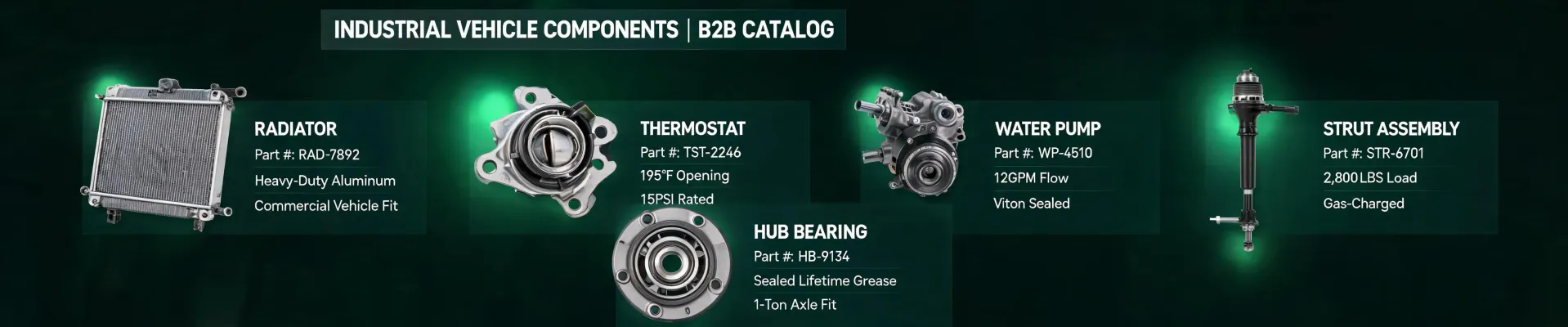
Water pump bearings are a good example. A water pump bearing does three jobs: supports the shaft, seals coolant, and spins. If any one fails, the engine overheats. People think expensive bearings fail less because they're expensive. Actually, they fail less because they're consistent.
In Q1 2024, I measured 100 KOYO water pump bearings and 100 no-name bearings from two different batches. KOYO: one unit slightly outside spec on axial play, still usable. No-name: seven units outside spec, including two with rough rotation. Seven percent may not sound huge. But a failed water pump bearing on a modern engine usually costs more than the bearing itself.
I don't expect anyone to repeat my bench test. The point is simple: if you're buying cooling parts, ask for test data. If the supplier can't show it, you're buying hope.
KOYO K Swap Radiator vs 'It Fits, Just Bend the Mount'
A K Swap radiator isn't just a box of coolant. It has to clear the alternator, line up with the hoses, locate the bleeder in a useful spot, and sit at the right height in the core support. When a customer orders a KOYO K Swap radiator, they're buying fitment verification, not just aluminum.
I've seen universal radiators where the builder had to cut the core support, stretch a hose, and add three washers under one mount. Did it work? Eventually. Would I want that on a customer's car? No.
Here's where the small-friendliness comes in. I've been the guy ordering one part, not fifty. Vendors who treated those small orders seriously are the ones I still buy from. A radiator doesn't know if it's going on a project car or a production build. The quality should be the same.
What Actually Makes a Part OE-Grade?
People use OE-grade loosely. To me, it means the supplier can demonstrate three things: material traceability, dimensional control, and test verification. The automotive quality standard IATF 16949 exists to push suppliers in that direction. It's not a guarantee, but it's a system. When a part has a real brand behind it, you can usually find those systems. When a part comes in a white box, you can't.
Does that mean white-box parts are always bad? No. It means you become the quality department. Are you ready to measure every bearing, inspect every bracket, and test every sensor? For most people, no. That's why brand names still matter.
Brake Pad Replacement Specials and KYB Struts: Cheap Becomes Expensive
I'm not against brake pad replacement specials. Some of those deals are legitimate loss leaders that bring in customers. But if a shop advertises brake pad replacement specials, the first question should be: what pads are in the box? A cheap set of pads can work fine for a commuter. The same pads can overheat on a loaded SUV.
Brakes are about friction material, shims, and wear sensors. A special that swaps in a cheap rotor and a low-grade pad will save money once. It will cost time and maybe an accident later.
Same logic with a KYB strut. A genuine KYB strut from an authorized distributor is a known replacement part. If the deal seems too good to be true, it probably is. The valving, the rod seal, the mounting bushings—those matter. I'd rather pay for a verified genuine strut than gamble on a lookalike.
What Causes Crankshaft Sensor to Go Bad? Usually Something Else
Here's the comparison that doesn't look like one: replace the part vs find the cause. The question 'what causes crankshaft sensor to go bad' has an answer, but it's rarely 'the sensor itself.'
Last year, a customer brought in a car with a crankshaft position code. The first shop replaced the sensor. A month later, same code. The second shop found oil inside the connector. The timing cover was leaking, oil wicked up the harness, and the sensor got a false signal. The sensor wasn't the problem. The leak was.
Other common causes: excessive crankshaft endplay or a bent reluctor wheel that smashes the sensor, heat damage from an exhaust manifold, and chafed wiring grounds. People think a crankshaft sensor goes bad because it's cheap. It's often the opposite—the sensor is the victim of another failure.
So when you compare cheap sensor vs OE sensor, you're missing the real comparison. Is the root cause fixed? If not, even the most expensive sensor will fail again.
Small Orders, Same Standard
I've been on both sides of the counter. I once ordered a $200 sensor for my own car, and the supplier treated me like a nuisance. A year later, that same supplier needed my company's help with a stamping drawing. Guess which vendor I remembered.
I'm not saying every supplier with a minimum order quantity is wrong. Minimums exist for real production reasons. But a minimum order is not an excuse for sloppy communication, missing paperwork, or a lower inspection standard. If a vendor treats a one-piece order like it matters, that tells you more than any catalog page.
This is why I respect companies like KOYO for having distributors that support small buyers. You can order one KOYO water pump bearing or one KOYO K Swap radiator without being asked to justify your existence. That's not charity. It's how supply chains grow.
How to Choose: My Quality Inspector's Checklist
If you're trying to decide between KOYO and no-name parts, here's what I'd do:
- Ask for a material cert or test report. For critical parts, ask for PPAP (Production Part Approval Process) paperwork. OEMs use PPAP to prove a part meets design intent before launch (Source: AIAG PPAP manual).
- Measure, don't guess. A caliper and a straightedge catch a lot.
- Check the application. A K Swap radiator for a Civic is not the same as one for an S2000.
- Factor in the cost of failure. A $30 saving on a water pump bearing can turn into a $1,200 repair.
- Don't let a small order make you accept worse service.
On that last point: I don't care if you're buying one oil seal or 10,000 stampings. Small doesn't mean unimportant. In my opinion, small means potential.
So glad I don't have to buy a new engine because someone skipped a bearing inspection. If you're in the middle of a build, compare the data, not the decals. That's the only comparison that matters.

Elise Novak
Elise Novak is an automotive braking systems analyst specializing in brake pads, discs, rotors, calipers, shoes, drums, hoses, and complete brake kits. She uses UN Regulation 90 requirements and ISO 26867 dynamometer methods to examine friction stability, fade and recovery, wear, disc thickness variation, runout, and hydraulic integrity. Her work helps distributors, quality teams, and fleet buyers compare replacement parts, verify application suitability, and define incoming-inspection criteria.