Let me start with an admission: I used to judge orders by their line-item total. Eight years of handling automotive parts orders teaches you a lot about spreadsheets, but it can also teach you bad habits. A $90 order used to feel like noise. Then a single Koyo order changed the way I look at every customer.
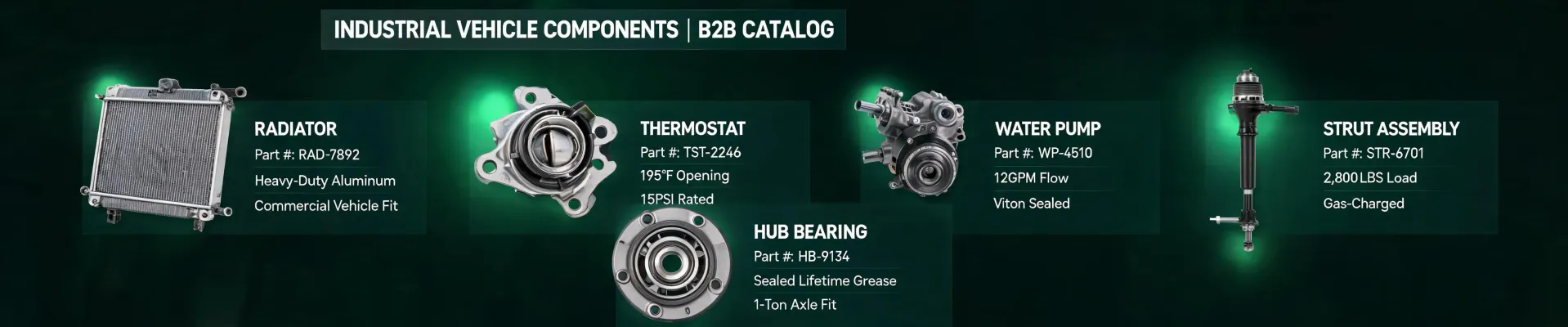
Here is my position: small orders are not 'test orders.' They are not warm-ups. They are the most honest signal a customer can send. A shop that takes time to source one Koyo radiator or a set of Koyo water pump bearings is doing something real. Treating that as a distraction is a mistake.
Small doesn't mean unimportant. It means potential.
Koyo Radiators and the Question of 'Worth It'
Customers asking about Koyo radiators rarely need a container-load. They need one radiator for a project car, a restoration, or a cooling system that deserves better than a budget replacement. One radiator. That is the whole job. If the person on the other end of your email makes them feel like their single-unit order is an inconvenience, they will remember that feeling longer than they will remember the price.
I almost made that mistake in March 2022. The order was for a single Koyo water pump bearing—not an assembly, not a hub, just the bearing. I knew I should verify the application before changing the quote. But I thought, 'What are the odds?' The odds were one in one. The customer had already done the research and knew exactly which bearing the pump rebuild needed. I caught the issue before shipping, but only because the note on the order saved me from my own assumption.
That moment changed how I think about small orders. I now keep a documented mistake checklist for my team, and the first line says: small order does not mean low information.
Spark Plug Removal Kit: Small Tool, Big Signal
The same lesson applies when someone orders a spark plug removal kit. It's a specialty tool, often for a customer dealing with a broken or over-tightened plug. They aren't looking for 'the cheapest option.' They are looking for a specific tool that solves a specific problem. If you ask about thread type, reach, or whether they are working on an aluminum cylinder head, you are not being annoying. You are building the kind of relationship that gets repeat business.
That question is part of the product. A customer who trusts you with a tricky tool question will trust you with a bigger parts order later. Not always. But often enough.
P0335 Crankshaft Position Sensor: Listen Before You Sell
A few months later, an independent shop called about a P0335 crankshaft position sensor code. The owner wanted to order a new sensor. I could have processed the sale and moved on. But my checklist said: Confirm the diagnostic story before quoting a replacement.
Per the SAE J2012 OBD-II standard, P0335 means the powertrain control module sees a problem with the crankshaft position sensor A circuit. That code can come from the sensor itself, but it can also come from a damaged wire, a poor ground, or a failing tooth on the crank trigger wheel.
'Did you inspect the harness near the crank pulley?' I asked. There was a pause. 'No,' the owner said. I gave him a quick voltage test procedure and asked him to check the wiring before buying anything. Thirty minutes later he called back. It was a chafed wire, not the sensor. He thanked me more than once.
Dodged a bullet. The sensor would not have fixed his car, and he would have asked for a return. Instead, he gained confidence in a supplier that helped him solve the actual problem. That is what I mean when I say diagnosis matters as much as the part.
Cabin Air Filter vs Engine Air Filter: There Is No Stupid Question
Let me talk about a question that gets laughed at too much: cabin air filter vs engine air filter. I have had shop owners laugh when a customer asks the difference. It is not a stupid question. It is a safety question.
The cabin air filter cleans the air entering the passenger cabin through the HVAC system. The engine air filter cleans the air entering the intake and combustion system. They serve different systems and are rarely interchangeable. The customer who asks is not clueless. They are being honest. That honesty should be rewarded with a clear answer, not a sigh.
And yes, I have seen a fresh cabin filter installed in an engine air box. It didn't end well. The car ran poorly, and the shop had to do the job twice. One question would have prevented it. This is why I tell our staff to answer the 'basic' question as carefully as the expensive one.
But What About Margins?
I hear the counterargument: 'You cannot build a business on $90 orders.' True. I am not asking you to. Large accounts pay the bills. But the mindset that treats small orders as annoying is bad for margins too.
In the last 18 months, the checklist born from my mistakes has caught 47 potential errors before they shipped. Many of those were small orders. Catching an error on a small order costs far less than catching it on a large one. And a small customer treated well can become a larger customer. Not a promise—just a pattern I have seen repeatedly.
One mechanic who ordered that $93 bearing later introduced us to a shop that buys radiators, bearings, and sensors monthly. Not a giant account. Consistent. That account started with a single bearing and a quick answer.
What I'd Tell My Younger Self
If I could go back to my first year in this industry, I would tell myself two things.
First, treat every order as a spec to verify, not a number to judge. Whether it's a Koyo water pump bearing, a spark plug removal kit, or a sensor for a P0335 code, the customer wants a correct answer more than a fast one.
Second, the question is part of the product. 'What's the difference between a cabin air filter and an engine air filter?' is not a nuisance. 'Can P0335 be a wiring problem?' is not a challenge. These questions are the reason you exist as a supplier.
I still like large orders. I just stopped using them as the only measure of a customer's value. The people who come to you with one Koyo radiator or one strange diagnostic code are not wasting your time. They are giving you a chance to prove that you listen. That is a small thing. It also happens to be everything.

Elise Novak
Elise Novak is an automotive braking systems analyst specializing in brake pads, discs, rotors, calipers, shoes, drums, hoses, and complete brake kits. She uses UN Regulation 90 requirements and ISO 26867 dynamometer methods to examine friction stability, fade and recovery, wear, disc thickness variation, runout, and hydraulic integrity. Her work helps distributors, quality teams, and fleet buyers compare replacement parts, verify application suitability, and define incoming-inspection criteria.